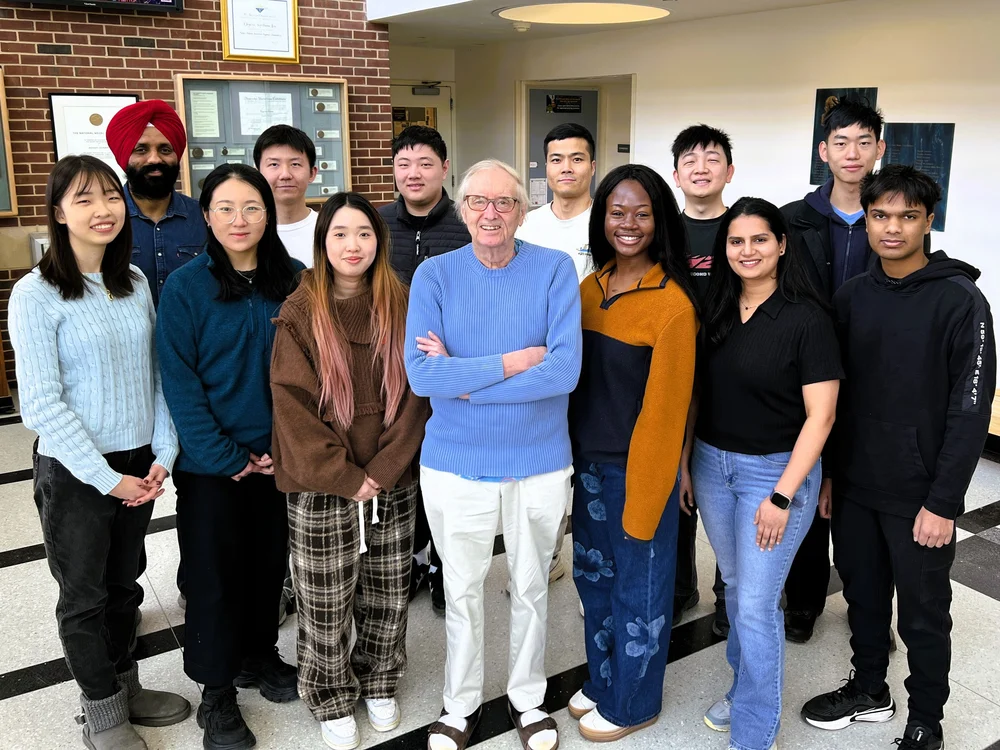
Prof. Eric Oldfield has thought about retiring—more than once—but his curiosity continues leading him in new directions to new research projects.
“I don't really understand the concept of retiring,” said Oldfield, who just began his 51st year as a chemistry professor at Illinois.
He is one of only a handful of current Illinois faculty members and staff beyond the 50-year mark and the first faculty member in chemistry to surpass a half century as professor. In the thick of some potentially impactful drug-related research, Oldfield has no immediate plans to retire.
“The good thing about this job is they pay you to do what you'd pay to do,” said Oldfield, who explained that he got a head-start on his career because he got his Ph.D. in the UK, where students finish much earlier than in the US, so can get into a faculty position sooner.
The spry 77-year-old still teaches a physical chemistry lab course every semester and leads a research group of five postdocs and ten undergraduates. Using x-ray diffraction, computational chemistry, nuclear magnetic resonance, and synthesis methods, his group is currently developing new antibiotics, anti-parasite drugs, and anti-cancer drugs. The group just published a paper in February about their latest research exploring the potential of drugs designed to reduce bone loss, treat osteoporosis, and manage metastases could be good candidates for antifungal drug leads.
And just last year, Oldfield was part of an international team of scientists who received the Chemistry Biology Interface Horizon Prize from the Royal Society of Chemistry for developing a comparative lipidomics platform, combining chemical synthesis, bioinformatics, and human immunology with the aim to fight tuberculosis and other infectious diseases.